
Some Changes to Charitable Giving with the New Tax Law

The One Big Beautiful Bill Act of 2025 (OBBBA) made some changes to the charitable deduction.

Charitable Deduction for Non-Itemizers or People Who Take the Standard Deduction

Beginning in 2026, individuals who do not itemize deductions may claim a cash gift deduction of up to $1,000 for single filers and $2,000 for married filing joint filers. Individuals who take the standard deduction, now qualify for a charitable deduction.

If Itemize, Subject to 0.5% AGI Floor on Charitable Deductions

Beginning in 2026, individuals who itemize, are subject to a  0.5% adjusted gross income (AGI) floor.  That is, only charitable contributions in excess of 0.5% of your adjusted gross income (AGI) are deductible.  For example, if your AGI is $75,000, only charitable gifts that exceed $375 will qualify as a deduction. 

Ceiling or Cap on Itemized Deductions for High-Income Taxpayers

For those high-income individuals in the top 37% tax bracket, the tax benefit from all itemized deductions, not just charitable contributions, will be capped at a 35% tax rate. The value of itemized deductions for those in the highest tax bracket will be reduced to 35% of the deduction amount, down from the current 37%, The tax benefits received will decrease from 37 cents per dollar donated to 35 cents per dollar donated.

Planning Strategies

Timing of Contributions

Make Contributions in 2025

For planning purposes, it may be more beneficial for taxpayers who itemize to make contributions in 2025 when there is no floor in place, especially if a large donation is considered. Individuals who itemize and high income taxpayers may want to give more in 2025, to avoid the new floor and cap/reductions to the charitable deductions that start in 2026.

Going forward, it may be beneficial for taxpayers to consider making contributions in a year when AGI is lower, so that the floor amount is lower.

Charitable Bunching Strategy

This is a plan to make several years of donations in a single tax year. “Bunching” donations, making larger contributions in one year, to maximize the deductions under the new tax rules. 

Donor-advised funds (DAFs)

DAFs provide a way to contribute cash, stock, or other assets to get an immediate tax benefit in the year of funding. The funds contributed are invested and can grow tax-free. The donor can choose how they are invested and when the money goes to charities, immediately or over time.

Qualified Charitable Distributions (QCDs)

For clients age 70½ and over, qualified charitable distributions (QCDs) provide a way to donate to charity that avoids the new deductibility floor and ceiling. Generally, QCDs are donations to charity directly from an individual retirement account (IRA). QCDs can have benefits, especially for taxpayers who have required minimum distributions (RMDs).

If you have an individual retirement account (IRA) and are over the required minimum distribution age, consider qualified charitable distributions (QCDs). A QCD lets you transfer up to $100,000 per year directly from your IRA to a qualified charity without having to include the distribution in taxable income. It also counts toward your Required Minimum Distribution. If you do not itemize because the standard deduction is better, a QCD is especially attractive. And for those who itemize, it sidesteps the impacts of the 0.5% AGI floor and the 35% cap on tax savings.

START DATE FOR 2024 TAX SEASON

Monday, January 29, 2024 is the official start date of the 2024 Tax Season

The IRS has announced that Monday, January 29, 2024 is the official start date of the nation’s 2024 Tax Season. It is when the agency will begin accepting and processing 2023 tax returns. However, people can start working on their taxes prior to that, either with a tax professional or software company. January 29th is the first day that the 2023 individual tax returns can be electronically filed with the IRS.

FILING DEADLINE FOR 2023 TAX RETURNS

Monday, April 15th, 2024 is Tax Filing Deadline for Most Taxpayers for 2023 Returns

April 15, 2024

Taxpayers Who Live In MA or ME Have Until April 17, 2024 to File Their Returns

The filing deadline for most taxpayers to submit 2023 individual tax returns, pay any taxes or file an extension is Monday, April 15, 2024. Because of the Patriots’ Day holiday on April 15 in Maine and Massachusetts and the Emancipation Day holiday on April 16 in the District of Columbia, taxpayers who live in Maine or Massachusetts have until April 17, 2024 to file their returns.

income tax filing deadline moved to july 15

Additional time to file and make payments without interest or penalties

The income tax filing deadline is now July 15. Treasury Secretary Steven Mnuchin announced in a tweet that all taxpayers and businesses will have additional time to file income tax returns and make any payments, without facing interest on payments or penalties for late filing.

Taxpayers may delay filing and paying 2019 Federal income taxes that would have been due on April 15. The new due date is July 15, 2020. This delay applies to taxes due of up to $1 million. This relief applies to all taxpayers, including trusts and estates. Corporations may also delay paying taxes of up to $10 million. Many states, including Massachusetts, have announced that they will follow Federal relief guidelines.

On the MA DOR website, it says: “In the event the Internal Revenue Service (IRS) issues tax relief to taxpayers with federal filing obligations, DOR is prepared to follow the IRS in offering similar relief for taxpayers with Massachusetts tax filing obligations. “

The due date for Federal estimated tax payments that would have been due on April 15 for 2020 is also postponed to July 15.

These measures are being enacted to help Taxpayers navigate through the economic effects of COVID-19 (coronavirus). Individual Taxpayers and Businesses will be able to use the money they would have paid to the IRS to meet other needs during the economic crisis related to COVID-19 containment measures.

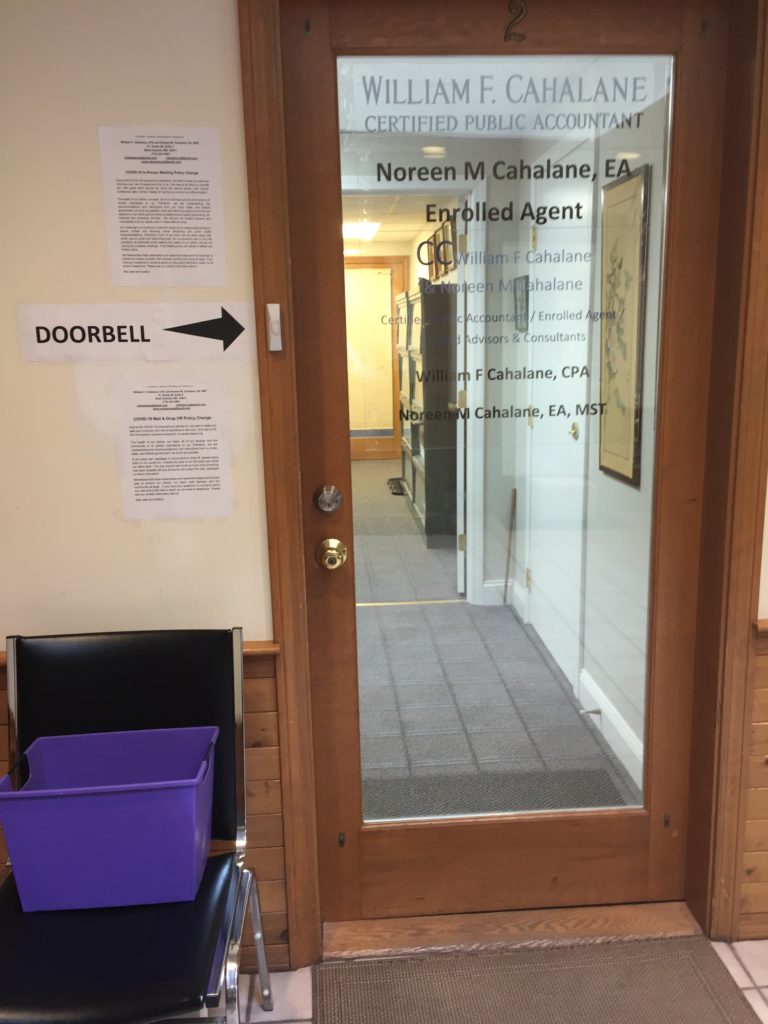
COVID-19 In-Person Meeting Policy Change

William F. Cahalane, CPA and Noreen M. Cahalane, EA, MST – New Meeting Policies

Due to the COVID-19 (coronavirus) pandemic, we want to keep you safe and minimize your risk of exposure to the virus. One way to do this is to provide you with great client service by using our secure portal, mail, phone, conference calls or email, instead of having you come to our office location. 

The health of our clients, our team, all of our families and the community is of utmost importance to us. Therefore, we are implementing the recommendations and restrictions from our local, state, and federal government, as much as possible, while still delivering personal service and attention to our clients and providing professional and quality accounting, tax, financial and consulting services.  We strive to be trusted advisors and consultants to all our clients, even in these difficult times.  

Our challenge is to continue to meet the needs of our clients while limiting in-person contact and following social distancing and public health recommendations. Thankfully much of our work can be done using mail, email, secure portal and teleconferences. As a precaution and to limit the possibility of transmittal while meeting the needs of our clients, we are not having any in-person meetings.  This meeting policy will remain in effect until further notice.

We believe that these reasonable and responsive steps are the best way to protect our clients, our team, their families, and the community at large.  If you have any questions or concerns about our new policy feel free to reach us by email or phone.

Stay safe and healthy!

Age increased to 72 for RMD from retirement accounts

For People Who Turn 70 1/2 After December 31, 2019

Included as part of a government spending bill that was signed into law December 20, 2019, The Setting Every Community up for Retirement Enhancement Act of 2019 (the Secure Act) changes the age at which individuals must begin taking the required minimum distributions (RMDs) from retirement accounts. The SECURE Act increases the age at which individuals must begin taking RMDs to 72 from 70 1/2. However, the new law only applies to people who turned 70 1/2 after December 31, 2019. If a person turned 70 1/2 in 2019, or have already been required to take RMDs, the law does not apply.

Why e-file?

The IRS issued a Tax Tip (Issue Number 2020-25) on reasons taxpayers should electronically file (e-file) their taxes.

IRS Tax Tips – Tax Tip 2020-25, February 26, 2020

The IRS top reasons why taxpayers should file electronically are:

It’s safe and secure.

E-file is often free.

It’s available through many convenient options.

It’s accurate and easy.

People who e-file get faster refunds.

It can be used whether a taxpayer is getting a refund or needs to make a payment.

See the IRS Issue Number: Tax Tip 2020-25 for more details.

are you Withholding enough tax?

The Tax Cuts and Jobs Act (TCJA) significantly changed the U.S. tax code. As a result of TCJA, the new tax withholding tables, which tell employers how much to withhold from employee’s paychecks, were issued to incorporate the changes. In the first year, the IRS probably had employers not withhold enough from employees, as the Administration wanted taxpayers to see an increase in their paychecks throughout the year, due to the tax law change. Many taxpayers probably did not really notice the increase, but they did notice getting less of a refund, or owing money when they filed their 2018 tax returns. Unknowingly, many taxpayers did not have enough money withheld from their wages, which is why they received less of a refund or owed money.

All taxpayers should review their withholdings to make sure that they are paying in enough. The IRS has a Tax Withholding Estimator that they recommend all taxpayers use. The IRS has been promoting their estimator and the new Form W-4, Employee’s Withholding Certificate, so that taxpayers do not have the same unexpected surprises when they file their 2019 tax returns.

Check Your Withholding

IRS Paycheck Checkup – Taxpayers should use the IRS Tax Withholding Estimator to perform a Paycheck Checkup and adjust their withholdings by filing a new Form W-4 with their employer, if needed.

Many tax professionals have been working with their clients to make sure their withholding for the year is enough to cover their expected tax liability. Taxpayers can also make quarterly estimated tax payments to cover the payment of additional tax expected to be owed.

Check your annual withholding using the IRS Tax Withholding Estimator or checking in with your tax professional.

Some places to find Tax Professionals

America’s Tax Experts – Find a Tax Expert
Tax Professionals – Find a TaxPro

IRS Directory of Federal Tax Return Preparers

Income Tax Refunds

Refunds May Be Delayed

Refunds may be delayed due to the partial government shutdown. Many IRS employees have been recalled, but some employees are claiming hardship exemptions. After not getting paid for a month, employees can actually not afford to go to work without pay, because they have no money to commute to work and pay for child care.

Hardship Exemptions

Under their union contract, IRS employees are allowed to miss work, if they suffer a hardship during a shutdown. The hardship exemption allows IRS employees not to have to use sick days to be absent from work.

File Returns Electronically with Direct Deposit of Refunds

With many employees claiming hardship and not working, the government’s ability to process refunds timely may be affected. We recommend filing returns electronically with direct deposit as a way to mitigate any possible delays.

Filing Deadlines for 2018 Tax Returns

Monday, April 15th is Tax Filing Deadline for Most Taxpayers for 2018 Returns

April 15, 2019

Taxpayers Who Live In MA or ME Have Until April 17, 2019 to File Their Returns

The filing deadline to submit 2018 tax returns is Monday, April 15, 2019 for most taxpayers. Because of the Patriots’ Day holiday on April 15 in Maine and Massachusetts and the Emancipation Day holiday on April 16 in the District of Columbia, taxpayers who live in Maine or Massachusetts have until April 17, 2019 to file their returns.